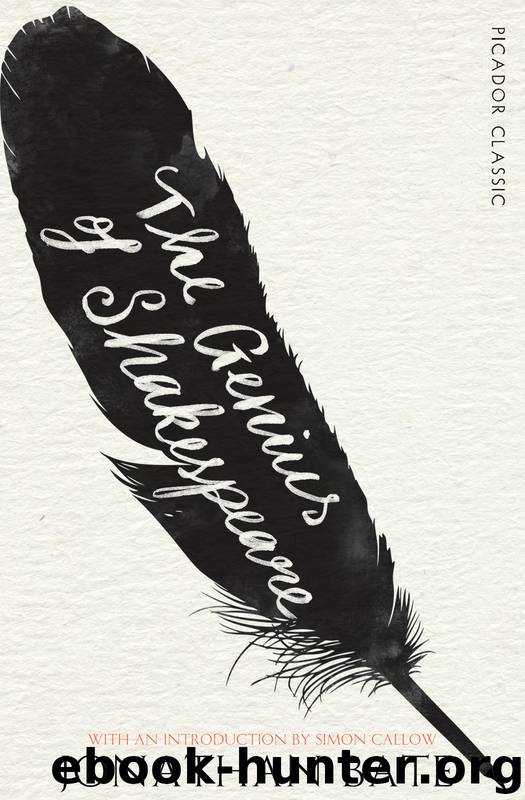
The Genius of Shakespeare by Jonathan Bate
Author:Jonathan Bate [Bate, Jonathan]
Language: eng
Format: epub
Publisher: Picador Classic
Published: 2016-12-23T05:00:00+00:00
A. C. Bradley, writing under the influence of Morgann and Hazlitt, picked up Nell Quickly’s image of Falstaff in Arthur’s bosom: ‘We wish Henry a glorious reign and much joy of his crew of hypocritical politicians, lay and clerical; but our hearts go with Falstaff to the Fleet, or, if necessary, to Arthur’s bosom or wheresomever he is.’ According to Bradley, the essence of Falstaff is ‘the bliss of freedom gained in humour’. As always with Bradley, the essay takes on an other-worldly tone: instead of assimilating Shakespeare to his own late Victorian liberalism, the critic makes Falstaff’s freedom a ‘freedom of soul’, an escape from the tawdry world of day-to-day politics into the infinity to which Bradley’s distinctive brand of Christianized Hegelianism gives access. He really wants Falstaff to be in heaven, to be in Abraham’s bosom. But the point about Arthur’s bosom is that it is an earthly, an English, and a temporary resting place: the conceit is that Falstaff will rest with Arthur under Glastonbury Tor not for all eternity but until the land has need of him again, when he will return.
In Henry V, his spirit has no sooner left than it does return, reanimated in his friends who follow the wars in France. Throughout the Henry plays there is a counter-movement to Hal’s growth into the bellicose kind of patriot-Englishman: a confused but vibrant prose voice is counterpointed against the polished verse of law, order, and military glory. Harry spurs ‘you noblest English’ on to the breach, but seconds later we hear the sanity of the boy who was Falstaff’s page: ‘Would I were in an alehouse in London. I would give all my fame for a pot of ale, and safety.’ Justice Shallow remembers when Sir John himself was a page; this boy who yearns for ale and safety is a pint-sized Falstaff already out from under Arthur’s bosom. After Agincourt, the King thanks God that fewer than thirty English have been killed in the battle. In his listing of the dead, he does not mention Falstaff’s proxies, yet they are the ones whom the audience mourns most: Bardolph and Nym, hanged; the boy, killed with the luggage; Nell, dead in the spital of a malady of France. They have died not for Harry’s but for Falstaff’s England, not for a palace or parliament in Westminster but for an alehouse in Eastcheap.
As prime embodiment of the Eastcheap crowd, Falstaff is Shakespeare’s primary means of access to those whom Edward Thomas called ‘the vital commoners’ and it is in this sense that he is England. He has somehow won himself a knighthood, but he has decayed from the gentry and is back among the commoners. His language is a living vernacular prose, richer in metaphor and invention than the verse of any of the plays’ noble speakers. He possesses no property, is always in debt, on the run from the law. If he has a home and a family, it is in the alehouse among his drinking companions: as Maurice Morgann put it, ‘he dies where he lived, in a Tavern’.
Download
This site does not store any files on its server. We only index and link to content provided by other sites. Please contact the content providers to delete copyright contents if any and email us, we'll remove relevant links or contents immediately.
Still Me by Jojo Moyes(11380)
On the Yard (New York Review Books Classics) by Braly Malcolm(5548)
A Year in the Merde by Stephen Clarke(5471)
Eleanor Oliphant Is Completely Fine by Gail Honeyman(5325)
The Bookshop by Penelope Fitzgerald(3900)
How Music Works by David Byrne(3328)
Surprise Me by Kinsella Sophie(3134)
Pharaoh by Wilbur Smith(3013)
Why I Write by George Orwell(2987)
Churchill by Paul Johnson(2633)
A Column of Fire by Ken Follett(2631)
The Songlines by Bruce Chatwin(2597)
The Beach by Alex Garland(2575)
Aubrey–Maturin 02 - [1803-04] - Post Captain by Patrick O'Brian(2319)
Heartless by Mary Balogh(2275)
Elizabeth by Philippa Jones(2228)
Hitler by Ian Kershaw(2221)
Life of Elizabeth I by Alison Weir(2117)
Harry Potter and the Cursed Child by J. K. Rowling & John Tiffany & Jack Thorne(2094)
